This section supplements the “LIS-SV”
product manual. The parameters described here are only available if the LIS-SV
is used in an ABULiner control unit.
Overview of the
'ABULiner' parameter level
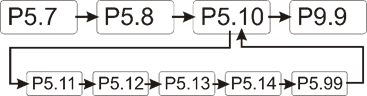
The following parameters can be set in the 'ABULiner'
parameter level of the LIS-SV.
|

|
Danger during setting work!
During setting work on the LIS-SV, monitoring of
the wire rope hoist is switched off. This means the wire rope hoist cannot
be monitored for excess load, among other things. This means the
wire rope hoist cannot be monitored for excess load, among other
things.
This in turn means the load could fall and kill or
injure people!
Do not use the crane for normal work during
setting work, and only lift loads very carefully for test
purposes! |
All LIS-SV parameters which are important for the ABULiner
are combined in a separate parameter level, which is shown as a submenu.
 Move the load hook out of
the limit switch range (up or down).
Move the load hook out of
the limit switch range (up or down).
During parameter setting, the load hook must not be within the
limit switch range.
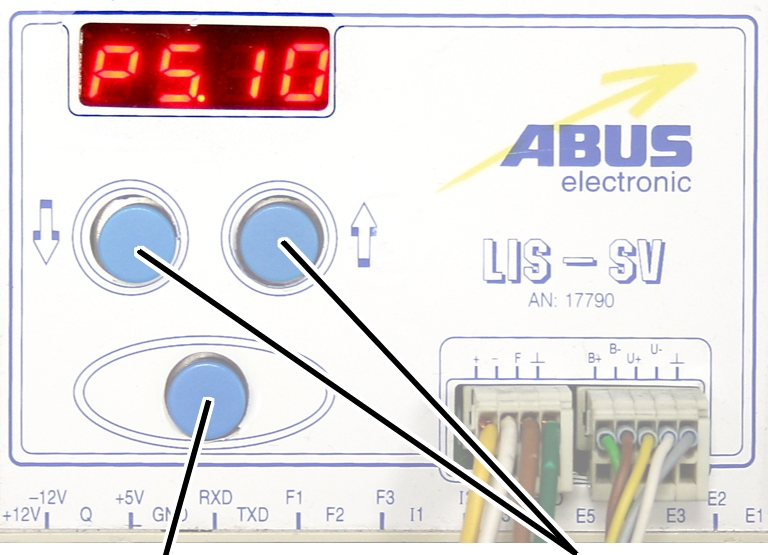
Open the menu of the
LIS-SV. See the documentation “Load indicator system LIS-SV”.
|
|
|
Enter
button |
Arrow
buttons |
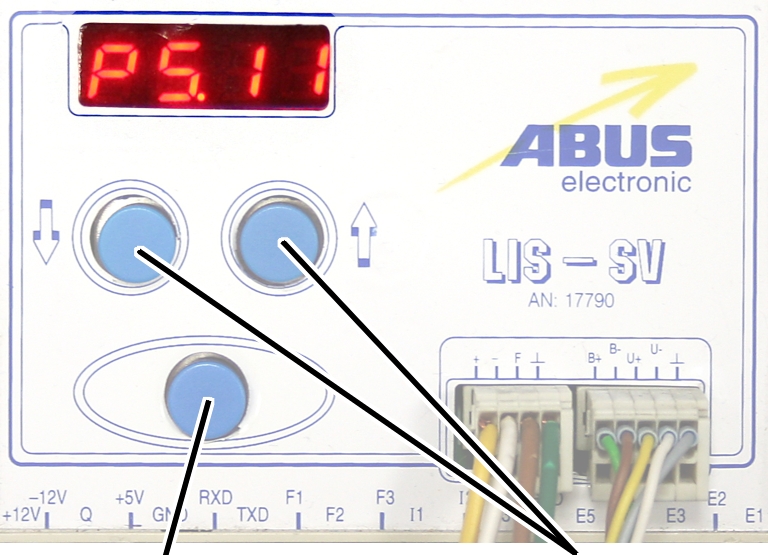
 Select parameter 5.10.
Press ENTER.
● The
'ABULiner' parameter level is activated.
● Parameter
5.11 is displayed.
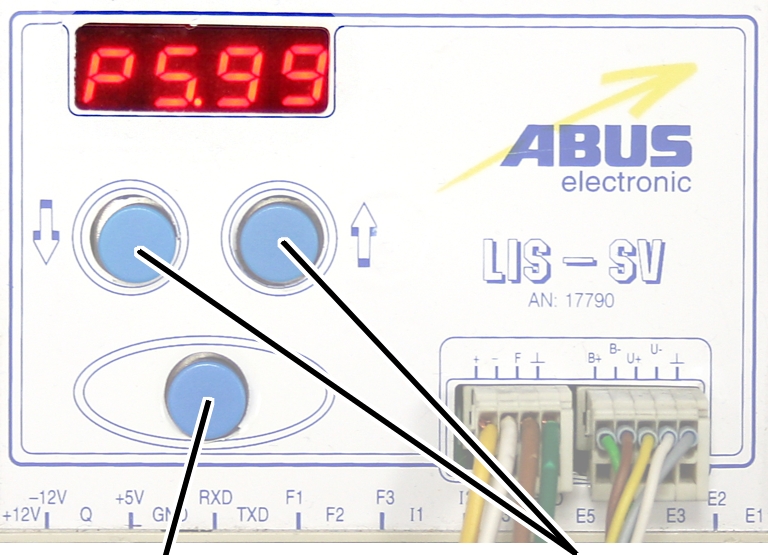
Exiting the
'ABULiner' parameter level
|
|
|
Enter
button |
Arrow
buttons |
Select parameter 5.99.
Press ENTER.
● The
previous parameter level is reactivated.
● Parameter
5.10 is displayed.
The LIS-SV is automatically activated for the ABULiner if a
value is entered for the parameter 5.11.
In the ABULiner mode (a value is set for parameter 5.11):
─ The
LIS-SV can monitor the total load for a maximum of two wire rope hoists.
─ Input F3
(normally used for measuring the load of wire rope hoist 3) now serves in
monitoring the current rotational frequency of the hoist motor.
─ A value
can be entered for parameter 3.0 (maximum load capacity of wire rope hoist 3).
If a value is entered for this, parameter 5.11 cannot be set.
─ This
interlocking thus excludes an incorrect setting.
─ The
load-controlled switching point at output TxD of the LIS-SV cannot be used.
─
Parameter 4.5 (setting for load-controlled switching point) is not available.
In the normal mode (no value is set for parameter 5.11):
─
Operation of the ABULiner Lifting/Lowering unit is not possible.
─ The
LIS-SV can monitor the total load for up to three wire rope hoists.
─ Input F3
serves in measuring the load of a third wire rope hoist.
─ A value
can be entered for parameter 5.11 (gear ratio). If a value is entered for this,
parameter 3.0 cannot be set.
─ This
interlocking thus excludes an incorrect setting.
─ The
load-controlled switching point at output TxD of the LIS-SV can be used.
─
Parameter 4.5 (setting for load-controlled switching point) can be used.
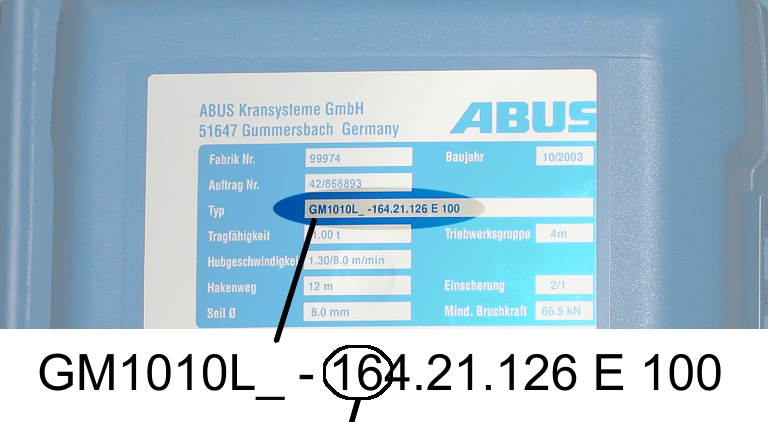
The LIS-SV uses the signal of the encoder and the gear ratio
of the hoisting gear to calculate the hook travel distance, the maximum distance
in the limit switch range and the current rotational frequency of the hoist
motor. The gear ratio must be set on the machine.
|
|
|
Cable
speed |
|
Read off the type
designation at the type plate of the wire rope hoist.
Read off the cable
speed.
From this table, select
the gear ratio that matches the cable speed.
|
|
Cable
speed |
|
Hoist motor GM |
32 m/min at 50 Hz
38 m/min at 60
Hz |
25 m/min at 50 Hz
30 m/min at 60
Hz |
20 m/min at 50 Hz
24 m/min at 60
Hz |
16 m/min at 50 Hz
19 m/min at 60
Hz |
|
800.4 |
50.01 |
63.49 |
77.77 |
98.16 |
|
800.5 |
47.03 |
60.04 |
74.66 |
95.03 |
|
1000.6 |
54.43 |
68.91 |
84.00 |
105.1 |
|
1000.7 |
54.60 |
68.06 |
81.45 |
104.6 |
|
2000.3 |
58.22 |
74.23 |
91.19 |
118.4 |
|
3000.4 |
73.61 |
93.92 |
118.4 |
152.9 |
|
5000.3 |
85.14 |
109.3 |
132.8 |
169.0 |
|
5000.4 |
80.20 |
104.9 |
127.7 |
160.6 |
|
6000.3 |
94.69 |
118.5 |
149.6 |
182.7 |
|
7000.1 |
118.0 |
148.3 |
182.6 |
232.0 |
|
|
|
|
|
|
Table: Gear ratios (numerical values) depending on
hoist motor (lines) and cable speeds (columns) at 50 and 60 Hz.
|
|
|
Enter
button |
Arrow
buttons |
Move the load hook out of
the limit switch range (up or down).
During parameter setting, the load hook must not be within the
limit switch range.
Select parameter 5.11.
Press ENTER.
● The set
value is displayed.
If the value is 0.00, the function is deactivated.
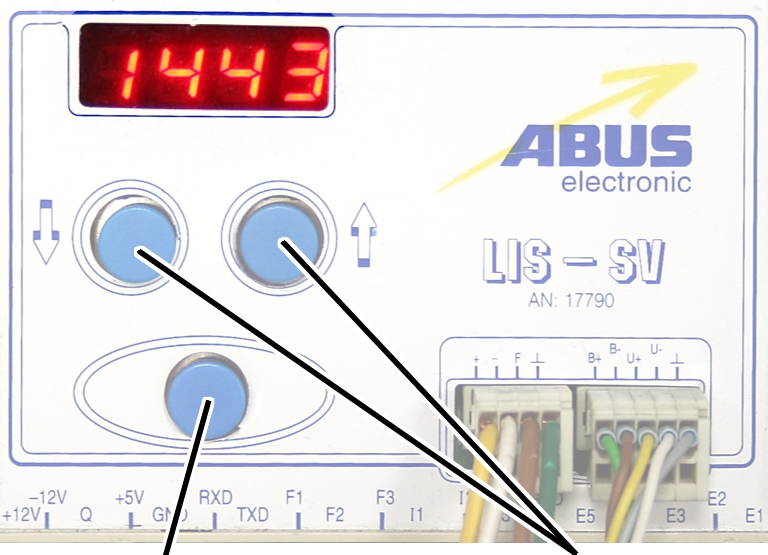
● Hold ENTER
pressed.
● CODE is
displayed.
Hold ENTER pressed.
|
|
|
Enter
button |
Arrow
buttons |
Enter the code 1443.
Press ENTER briefly.
|
|
|
Enter
button |
Arrow
buttons |
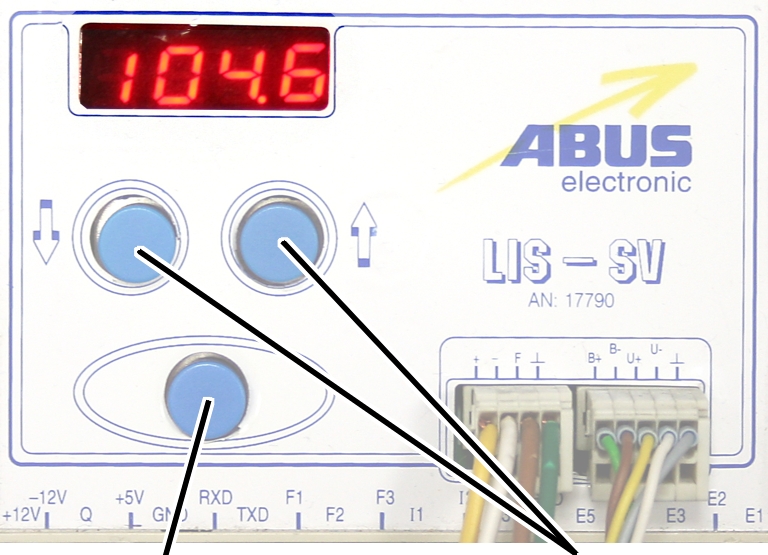
Set the value from the
table.
If the display ‘0.00’ cannot be changed, a value is set in
parameter 3.0. In this case, set the value to zero first.
Press ENTER briefly.
Sybase - Iq 161 Download Link
“If I download a cracked version from a random site, they’ll find something wrong. And if I get a wrong build, we waste days. No—this has to be a clean, supported path.” The Obstacles: Bureaucracy and Memory Her first stop was her company’s internal server. “Any chance someone archived 16.1?” she asked. Her junior developer, Raj, squinted. “Hmm… I think Mike in the old DB team had it. He left last year, but maybe he left a backup?” Raj dug through the network drives but found only 16.2+.
Sybase IQ is now a chapter in SAP’s history, but for developers like Elena, its code lives on in the archives, waiting for those who need it—and the resourcefulness to retrieve it.
Potential pitfalls: Don't make the story too technical unless it's necessary. Balance between the technical aspects and the narrative. Maybe include some dialogue or internal monologue to make it relatable. Also, highlight the importance of proper documentation and support when dealing with legacy software. sybase iq 161 download link
I should also verify if Sybase IQ 16.1 is still available for download. From what I know, SAP maintains certain versions but sometimes they archive older versions on their support sites. So in the story, perhaps the character has to find an old link from an internal network or a colleague's machine.
Sybase IQ, a relational database optimized for data warehouses, had been a pioneer in its time, but by 2010, SAP (Sybase’s parent company) had shifted focus to newer tools. Version 16.1, released in 2013, was the last stable iteration before the product’s redesign. Official repositories had long since purged it. Elena began, as always, with Google. Typing “Sybase IQ 16.1 download link” yielded a labyrinth of dead ends. SAP’s official support site only provided 16.2+. Forums mentioned old links, but they were defunct. Reddit threads whispered of “internal archives” and “colleague’s old machines,” but Elena knew the risks of unofficial downloads—malware, legal gray areas, and version mismatches. “If I download a cracked version from a
I need to make the story engaging. Maybe add some tension, like being on a tight deadline. Maybe the character has to use problem-solving skills or think creatively to find the resource. Also, include technical details that are accurate—explain what Sybase IQ 16.1 is, why it's needed over newer versions. Maybe the project requires legacy compatibility.
Also, the legal aspect: downloading older versions from unofficial sources might not be recommended, so the story should model appropriate behavior, like contacting official support. “Any chance someone archived 16
Start with introducing the main character, maybe a software developer or IT professional. They need to download Sybase IQ 16.1 for a client project. The problem is that the official website no longer hosts older versions. They have to find the link through other means—like forums, old documentation, or a colleague who has stored a copy. Conflict arises when they face roadblocks, like dead links or security issues. Maybe some parts of the website have moved, or require authentication. They might have to contact SAP (since SAP acquired Sybase) support. Then resolve the issue by getting the link through proper channels.
Only for auxiliary fans
The auxiliary fan of the hoist motor continues to run for
several minutes after the lifting or lowering. This ensures that the hoist motor
is adequately cooled even at slow lifting speeds. The run-on time can be
adjusted.
|
|
|
Enter
button |
Arrow
buttons |
Move the load hook out of
the limit switch range (up or down).
During parameter setting, the load hook must not be within the
limit switch range.
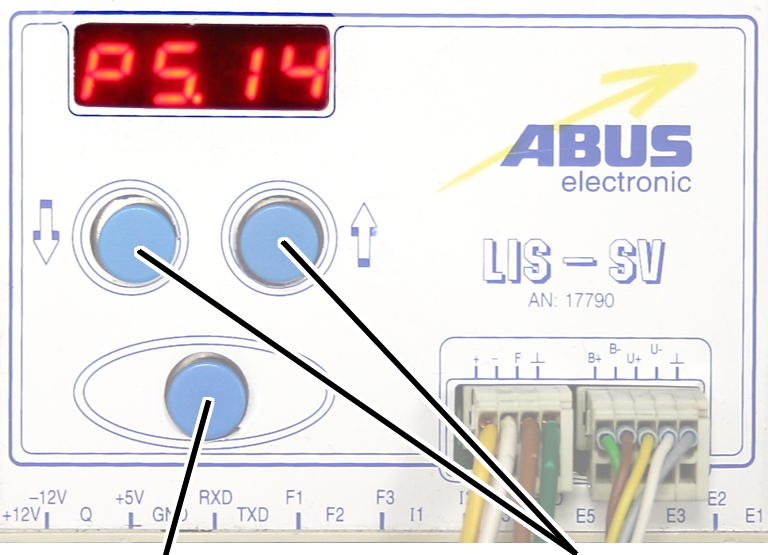
Select parameter 5.14.
Press ENTER.
● The set
value is displayed.
|
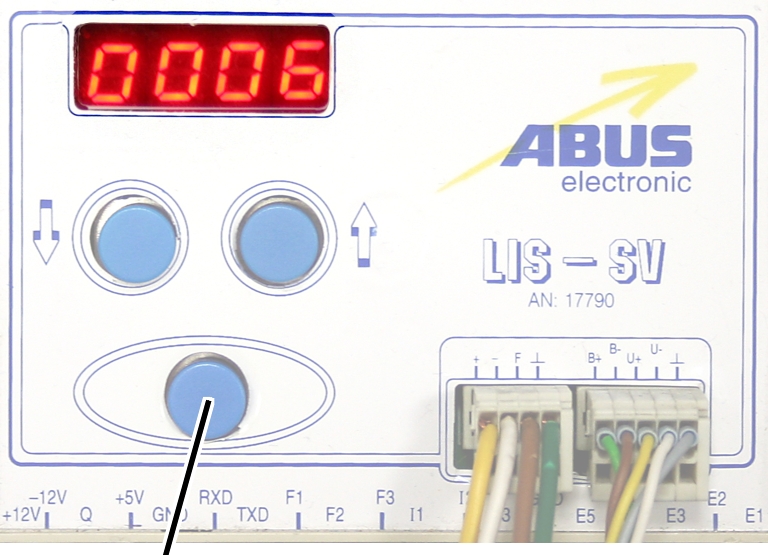
|
|
Enter
button |
|
Set the value to between 3
and 10 minutes using the arrow buttons.
Press ENTER.